
Qatar National Animal: Arabian Oryx Facts and Where to See It
From near extinction to national symbol, the complete guide to Qatar's beloved white oryx in 2026.
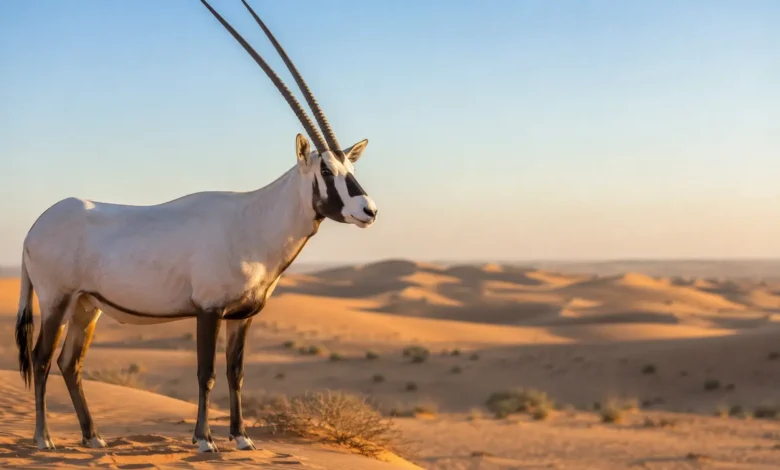
Qatar’s national animal is the Arabian Oryx. Additionally, Known scientifically as Oryx leucoryx, it is also called the White Oryx. This elegant desert antelope has lived on the Arabian Peninsula for thousands of years. Today, it stands as one of the most powerful symbols of Qatar’s identity, resilience and conservation success.
Along with the Qatar National Flower (Qataf), Sidra Tree and Qatar National Flag, the Arabian Oryx represents Qatar’s rich natural and cultural heritage.
This guide covers everything you need to know about the Arabian Oryx in 2026 from its physical traits and desert survival skills to its remarkable comeback from extinction and where you can see it in Qatar today.
Qatar’s National Animal: Arabian Oryx Explained
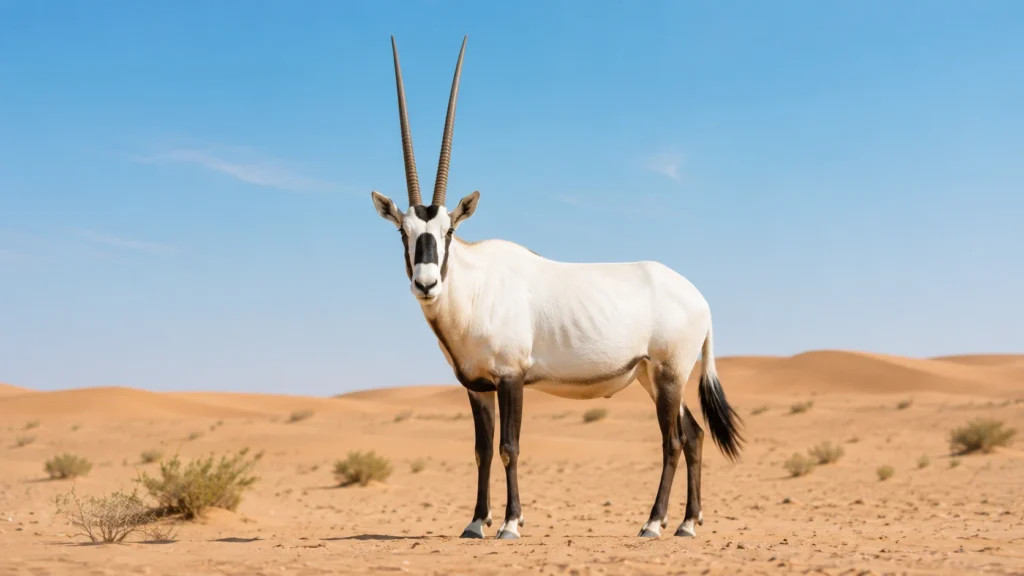
The Arabian Oryx is the official national animal of Qatar. It is a medium sized antelope native to the harsh deserts of the Arabian Peninsula. Qatar shares this national symbol with Jordan, Oman, the UAE and Bahrain but Qatar’s connection to the oryx runs deeper than most.
Quick Facts:
| Feature | Detail |
|---|---|
| Scientific Name | Oryx leucoryx |
| Common Name | Arabian Oryx / White Oryx |
| Arabic Name | مها (Maha) |
| Height | ~1 metre at shoulder |
| Weight | 65–100 kg |
| Horn Length | 70–75 cm |
| Lifespan | Up to 20 years |
| IUCN Status | Vulnerable |
| Native Region | Arabian Peninsula |
Arabian Oryx Appearance: Horns, Coat and Size
The Arabian Oryx is instantly recognisable. Its appearance is striking and perfectly designed for desert survival.
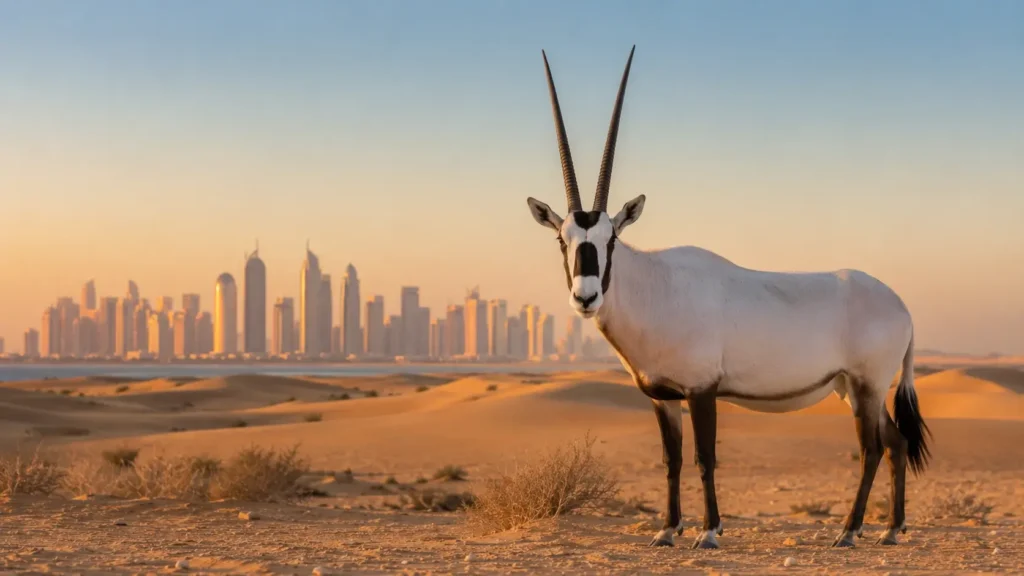
Its coat is pure white. This is not just aesthetic. The white fur reflects the intense desert sun and helps the animal regulate its body temperature. Dark chocolate brown patches mark the nose, cheeks and legs, giving it a sharp, almost painted look.
Both males and females carry long, slightly curved horns. These can grow over 70 centimetres. The horns serve two purposes, defence against predators and establishing dominance within the herd. When viewed from the side, the two horns overlap and appear as one. This is widely believed to be the origin of the unicorn myth in ancient literature.
The oryx also has broad, flat hooves. These act like natural snowshoes on sand, spreading the animal’s weight and allowing it to move easily across dunes and gravel plains.
Arabian Oryx Habitat and Desert Adaptations
Few animals on Earth are as well adapted to extreme conditions as the Arabian Oryx.
It thrives in arid plains, sandy deserts and rocky hillsides environments where temperatures regularly exceed 45°C. Rather than fight the heat, the oryx avoids it. It rests during the hottest parts of the day and moves and feeds in the cooler evening and early morning hours.
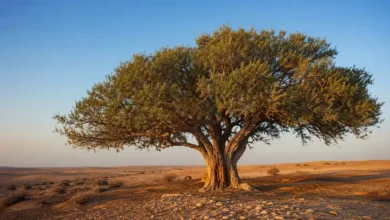
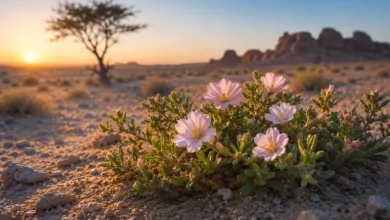
Native desert plants, including the Qataf flower and the Sidra tree, play an important role in supporting Qatar’s desert ecosystem.
Water is scarce in the desert. The oryx handles this by extracting moisture from the plants it eats grasses, herbs, tubers and roots. It can survive for weeks without drinking water directly. When rain falls, the oryx can detect it from a remarkable distance. The lead female then guides the herd toward the fresh vegetation that follows rainfall.
Herds typically range from 5 to 30 individuals. Males hold large territories. Dominance is established through posturing and display rather than physical fighting a strategy that avoids serious injury.
Why Is the Arabian Oryx Qatar’s National Symbol?
The Arabian Oryx was not chosen randomly. Every quality the animal represents resonates deeply with Qatari culture and history.
Like the Qatar National Flag and the Qataf flower, the Arabian Oryx is an important national symbol that reflects the country’s identity and heritage.
For centuries, Bedouin communities across the Arabian Peninsula admired the oryx for its stamina, grace and ability to endure. It could travel more than 70 kilometres in a single night across open desert. That kind of endurance was deeply respected by nomadic people who faced the same harsh landscape every day.
The oryx also carries cultural significance in Arabic poetry and literature. Classical Arabic verse frequently referenced the animal as a symbol of beauty, purity and quiet strength.
In modern Qatar, the oryx appears everywhere. Qatar Airways features a stylised oryx head on every aircraft tailfin. The airline adopted the symbol in the 1990s to reinforce national identity and connect the brand to Qatar’s heritage. The same motif appears in the Qatar Olympic Committee emblem and across national branding.
The most visible tribute is Orry the Oryx the beloved mascot created for the 2006 Asian Games in Doha. A 10 metre statue of Orry still stands on the Doha Corniche, watching over the city and the sea.
Operation Oryx: How the Arabian Oryx Came Back From Extinction
This is the most important part of the Arabian Oryx story and it is a story worth knowing in full.
By the early 1960s, the Arabian Oryx was disappearing fast. Motorised hunting parties were pursuing the last wild herds across the Arabian Peninsula. The animals had no defence against vehicles and automatic weapons. By 1972, the Arabian Oryx was declared extinct in the wild.
The response was Operation Oryx. In 1962, the Fauna and Flora Preservation Society of London, in partnership with the Phoenix Zoo and the World Wildlife Fund, captured a small number of wild animals to establish a captive breeding herd. Starting with just nine animals, the Phoenix Zoo produced over 240 successful births over the following decades.
Qatar played a direct role. Members of the Qatar royal family including Sheikh Qassim bin Hamad Al Thani established private oryx reserves and ran independent breeding efforts. In 1967, Sheikh Faisal bin Qassim Al Thani led an expedition to capture five animals in Oman. These became a breeding group in Qatar. In 1979, the Qatar government formalised this work by creating an official oryx park.
By 1982, captive populations had grown large enough to begin reintroduction to the wild. Animals were released in Oman, Saudi Arabia, Qatar and the UAE.
Then came the landmark achievement. In 2011, the Arabian Oryx became the first species in recorded conservation history to move from the IUCN Red List category of “Extinct in the Wild” back to “Vulnerable.” That reversal had never happened before. It has not happened since.
Arabian Oryx Conservation in Qatar Today
Qatar has not slowed down since 2011. Active conservation work continues across the country in 2026.
The Ministry of Environment and Climate Change oversees oryx protection in Qatar. Modern tools, GPS tracking, DNA profiling, drone surveillance monitor herd movements and health across multiple protected areas. Estimates suggest Qatar is now home to as many as 10,000 wild and semi-wild Arabian Oryx.
Key protected areas include:
- Al Shahaniya Reserve: Located west of Doha, this is Qatar’s primary dedicated oryx reserve and the largest breeding site in the country
- Al Reem Biosphere Reserve: A UNESCO-designated site in northwest Qatar, covering over 1,200 square kilometres of protected desert habitat
- Al Mas’habiya Reserve: Located in southern Qatar near the Saudi border, home to large semi-wild herds
- Al Maha Sanctuary: A smaller site offering eco-tourism access and guided wildlife experiences
Challenges remain. Genetic diversity, hybridisation with other oryx species and habitat encroachment from development continue to require active management. But the population trend is positive.
Where to See the Arabian Oryx in Qatar
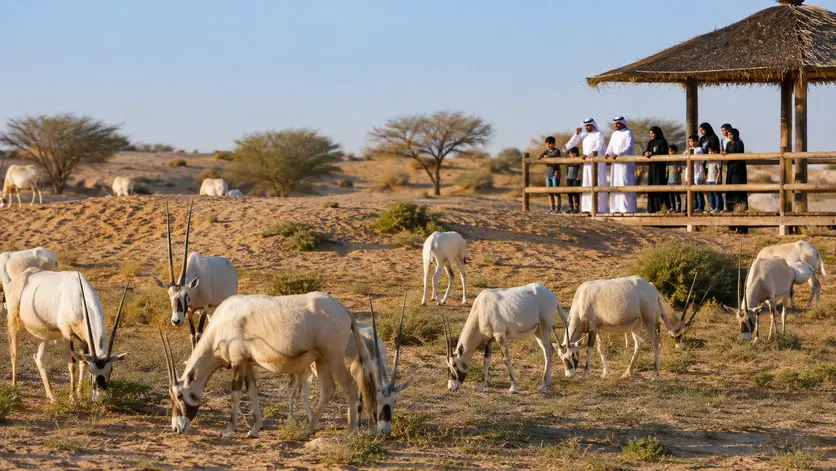
This is the question most visitors and residents actually want answered. Here is the Full answer of this question.
Al Shahaniya Reserve
Al Shahaniya Reserve is the best starting point. Located approximately 60 kilometres west of Doha off the Dukhan Highway, this is Qatar’s main oryx breeding centre. The reserve is not a standard tourist attraction access is limited and typically requires coordination with the Ministry of Environment. However, organised tours and educational visits are periodically available.
Al Reem Biosphere Reserve
Al Reem Biosphere Reserve in northwest Qatar offers a more open landscape where oryx roam in large, semi-wild conditions. The reserve spans a vast area of gravel plains and sabkha desert. Desert safari operators in Qatar occasionally include this area on their routes.
Desert safari tours
Desert safari tours from Doha are the most practical option for most visitors. Several licensed operators run evening and overnight trips into Qatar’s western desert, where oryx sightings are a regular occurrence especially near Al Shahaniya.
Tips for the best chance of a sighting:
- Visit in the cooler months: October to March
- Early morning and late afternoon are the best times
- Stay quiet and keep distance: oryx are alert and will move away from loud noise
- Book through licensed desert safari operators for guided access
Arabian Oryx in Modern Qatari Culture
The Arabian Oryx is not just a wildlife story. It is woven into Qatar’s cultural fabric.
Qatar Airways chose the oryx because it embodies the qualities the airline wanted to project elegance, endurance and a distinctly Arabian identity. The stylised oryx head on every tailfin is one of the most recognised airline logos in the world.
Orry the Oryx created as the mascot for the 2006 Doha Asian Games became a cultural icon that outlasted the event itself. The statue on the Corniche has become a favourite landmark and photo spot for residents and tourists alike.
The oryx also appears in Qatari art, architecture and design. It features in public murals, hotel lobbies, school textbooks and national day decorations. For Qatar’s younger generation, the oryx is as familiar a symbol as the national flag.
How Arabian Oryx Live: Herds, Mating and Behaviour
Understanding how the oryx actually lives adds depth to its story.
Herds are mixed-sex and typically range from 5 to 30 animals, though groups of up to 100 have been recorded in areas with abundant food. A dominant male leads the herd and maintains a large territory. Males establish hierarchy through visual displays and posturing lowering their heads to point their horns forward, rather than direct combat.
Mating follows a polygynous pattern, where one dominant male mates with multiple females. Pregnancy lasts approximately 240 days. Females typically produce one calf per year when conditions are good. Young oryx are weaned at around four months and reach sexual maturity between two and three years of age.
The oryx is generally non-aggressive toward members of its own herd. This social tolerance allows large groups to coexist peacefully an important adaptation for a grazing animal that needs to cover large distances together.
Frequently Asked Questions
The Arabian Oryx (Oryx leucoryx), also known as the White Oryx, is Qatar’s official national animal. It is a desert antelope native to the Arabian Peninsula.
The oryx represents endurance, beauty and survival qualities that resonate deeply with Qatar’s Bedouin heritage and desert landscape. It has appeared in Arabic poetry and culture for centuries and features prominently on Qatar Airways aircraft and national emblems.
No. As of 2026, the Arabian Oryx is classified as Vulnerable on the IUCN Red List a significant improvement from Extinct in the Wild, which was its status in 1972. It was the first species in history to move from “Extinct in the Wild” back to a lower threat category.
Al Shahaniya Reserve west of Doha is the main breeding centre. Al Reem Biosphere Reserve in northwest Qatar and desert safari tours from Doha also offer regular sighting opportunities. Best time to visit is October to March.
Qatar is estimated to have up to 10,000 wild and semi-wild Arabian Oryx across its protected reserves and private collections one of the largest populations in the world.
The Arabian Oryx is a herbivore. It eats grasses, herbs, roots, tubers and buds. It extracts moisture from its food and can survive for extended periods without drinking water directly.
The Arabian Oryx is known as مها (Maha) in Arabic, a name that also carries poetic connotations of beauty and grace in classical Arabic literature.
Interested in learning more about Qatar’s national identity? Explore our guides on the Qatar National Flower, Sidra Tree and the Qatar National Flag.